Richard "Dick" Kalich, Novelist | Home Richard "Dick" Kalich's Biography Richard "Dick" Kalich's Novels Letters & Reviews Films by Dick Kalich Contact Richard "Dick" Kalich Visit The Kalich Organization Website

upcoming novel
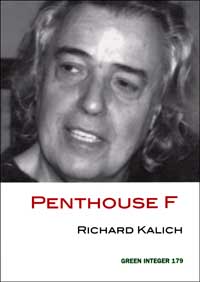
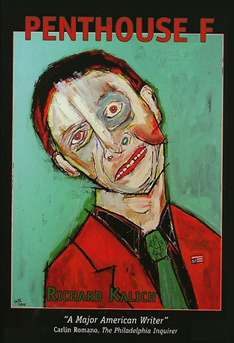
Penthouse F

by Richard Kalich


"A marvelous book. It manages to do with metafiction in a short novel what the great postmodernists like Coover and Barth take five or six hundred pages to do."

Penthouse F strikes me as an eminently publishable book, one that is not only original and unique, but also highly readable. Indeed, it seems to me that while the ideas behind the work are quite complex, the execution feels almost effortless - it's a real pleasure to read.

The boundaries between fiiction and reality are first crossed, then crossed again, then completely rearranged, in this slim but smart novel by the author of
CHARLIE P and The Nihilesthete, and the results are at once morbidly entrancing and thought provoking. A wonderful book."

- Brian Evenson, Director, Creative writing program, Brown University. Author of the novels, THE FATHER OF LIES and THE OPEN CURTAIN.


"If one of the great European intransigents of the last century - say, Franz Kafka or Georges Bataille or Witold Gombrowicz - were around to write a novel about our era of reality tv and the precession of simulacra, the era of Big Brother and The Real World, what would it look like? Well, it might look like Richard Kalich's PENTHOUSE F, a narrative of sexual (or is it aesthetic?) obsession and closed-circuit television, set in a recognizable twenty-first-century Manhattan but opening onto an interior space that both does and does not belong to our world - a space contiguous with those dark inner rooms that the European avant-gardists took us into. Right next door to PENTHOUSE F is the closet where the whipper whips his perpetual victim in THE TRIAL..."

- Brian McHale, is an American literary theorist, a seminal critical figure in post-modern studies, author of Postmodernist Fiction (1987), Constructing Post-Modernism (1992), and The Obligation Toward the Difficult Whole (2004).

In an era where literary fiction is a diminishing concern in everyday life, Penthouse F blurs the distinction between biography and fantasy, and turns the act of reading a novel into an investigation about the process of producing one's own reality. As a reality television predominates the landscape of popular culture, so too does Kalich's piece leave one puzzling as though on the terminator between light and dark, uncertain if such simple binaries as "night" and "day" or "fact" and "fiction" even have relevance in our world.

Kalich is able to make a pointed critical ethical examination of an increasingly passive generation not simply bearable, but delightful. The novel is frequently hilarious, populated with numerous character sketches that portray a substantial cross-section of American life with sensitivity and care. It repeatedly affirms the value of human connection, while cautioning against a delusion that the instantaneity of electronic media can replace the substantiality of genuine human relationships.
- Christopher Leise, Book Critic for Electronic Book Review


Letters

If one of the great European intransigents of the last century - say, Franz Kafka or Georges Bataille or Witold Gombrowicz - were around to write a novel about our era of reality tv and the precession of simulcra, the era of Big Brother and The Real World, what would it look like? Well, it might look like Richard Kalich's Penthouse F, a narrative of sexual (or is it aesthetic?) obsession and closed-circuit television, set in a recognizable twenty-first-century Manhattan but opening onto an interior space that both does and does not belong to our world - a space contiguous with those dark inner rooms that the European avant-gardists took us into. Right next door to Penthouse F is the closet where the whipper whips his perpetual victim in The Trial...

But why travel so far afield for analogues, when there are Americans closer to hand? This is the sort of novel that John Hawkes might have written if he had spent a few years obsessing about the obsolescence of literature and the tyranny of the Image - and if he'd reined in his baroque style and opted instead for the kind of deadpan mimicry of the everyday (with only occassional revelatory outbreaks) that characterizes Kalich's prose. Or this is the kind of novel that Ron Sukenick might have written, and in fact did write, in Blown Away - a dossier-novel, an archive of documents, some real, some faked, adding up (or not adding up, finally) to a reflection on the way we live now in the society of the spectacle. Or it's a novel of the kind that Mark Danielewski wrote in House of Leaves, and that Larry McCaffery calls avant-pop, avant garde invention grafted onto a pop-culture vehicle - here, an investigation in the familiar mode of a Law and Order episode - except that Kalich is spare where Danielewski is overblown, laconic where he is garrulous. Still, Kalich shares with Danielewski the effect of layering, of screens (cinematic, televisual, computer) intervening between us and the real, just as they also share a sense of the impenetrable darkness of the innermost recess. These novelists are unmistakably each other's contemporaries, and our contemporaries.

House of Leaves has sometimes been called a "cult novel," and I suppose that's what
Penthouse F is likely to become, too. The term "cult novel" has negative connotations - of freakishness, obsession, clannishness - but as far as I can make out, a "cult-novel" is really only a novel that finds its own audience without that audience having been targeted by professional marketers. It's sort of novel that makes its way by word of mouth; copies get handed off from reader to reader; readers, without prompting, treat it is though it contained coded messages about their own lives. An earlier instance is Fowle's The Magus, a novel that (as I recall) really did get handed off from reader to reader, and that, long after it had slipped off the bestseller list, continued to enjoy a long afterlife of readership. Not incidentally, Penthouse F actually bears a family resemblance to The Magus. Both involve powerful mentor-figures who play a dangerous "god-game" with vulnerable proteges - or, maybe that's what happens; but maybe not. Here again,. however, Kalich's approach to this material is reticent and astringent, where Fowle's is chatty and lush; he holds back, where Fowles piles on.

Penthouse F differs from a cult novel like The Magus in one crucial respect: it makes no pretense of being good for you. This is not redemptive literature; it's not consoling or improving; in fact, it's downright unwholesome. If you want therapeutic fiction, then consult Oprah's selections; Penthouse F is not the book for you. and this, finally, more than any similarity of style or storyworld, is what constitutes Penthouse F's kinship with those instransigent avant-gardists of the last century - with Kafka or Bataille or Gombrowicz - or even with Sade himself, who is something like this novel's patron saint, presiding over its closed circuits and its vicious games. None of them promises to make you a better person, whatever that might mean; none of them will help you be a more loving parent or partner, or improve your health or sexual performance, or give a boost to your career, or make you feel better about yourself, or free you from the burdens of your past, or extend your life, or reconcile you with death, or save your soul. Not a one of them,
Penthouse F included. sorry. They're just art, after all.
- Brian McHale, is an American literary theorist, a seminal critical figure in post-modern studies, author of Postmodernist Fiction (1987), Constructing Post-Modernism (1992), and The Obligation Toward the Difficult Whole (2004).

A note to say that I've now read through PENTHOUSE F, which I very much enjoyed. I think it quite a marvelous book, and like the way in which you interweave the fictional and the (simulcra of the) actual in a way that makes it very hard to distinguish one from the other. It manages to do with metafiction in a short novel what the great postmodernists like Coover and Barth take five or six hundred pages to do. That's quite nicely done, and the interrogation/trial aspect of it is very nicely handled as well. I like, too, the way in which the cruelty/sadism that we see in the Nihilesthete begins to resurface here, the way in which the Dick Kalich of the book is both someone it's easy to be sympathetic with and someone who, as the piece progresses, seems to have taken his manipulations of the boy and girl (if there really were a boy and girl) in very dark directions.

In short, PENTHOUSE F strikes me as an eminently publishable book, one that is not only original and unique, but is also highly readable. Indeed, it seems to me that while the ideas behind the work are quite complex, the execution feels almost effortless - it's a real pleasure to read.

It's also a book that I'd be happy to write a blurb for once you have a publisher. Something along the lines of: "The boundaries between fiction and reality are first crossed, then crossed again, then completely rearranged in this slim but smart novel by the author of CHARLIE P. and THE NIHILESTHETE, and the results are at once morbidly entrancing (in the vein of A.M. Holmes The end of Alice) and thought-provoking. A wonderful book."

- Brian Evenson, Director, Creative writing program, Brown University.
Author of the novels, THE FATHER OF LIES and THE OPEN CURTAIN.


HOME    BIOGRAPHy    novels    reviews    FILMs    contact    visit the kalich organization
Copyright 2007